For Our Students
My Complaints Picture Board
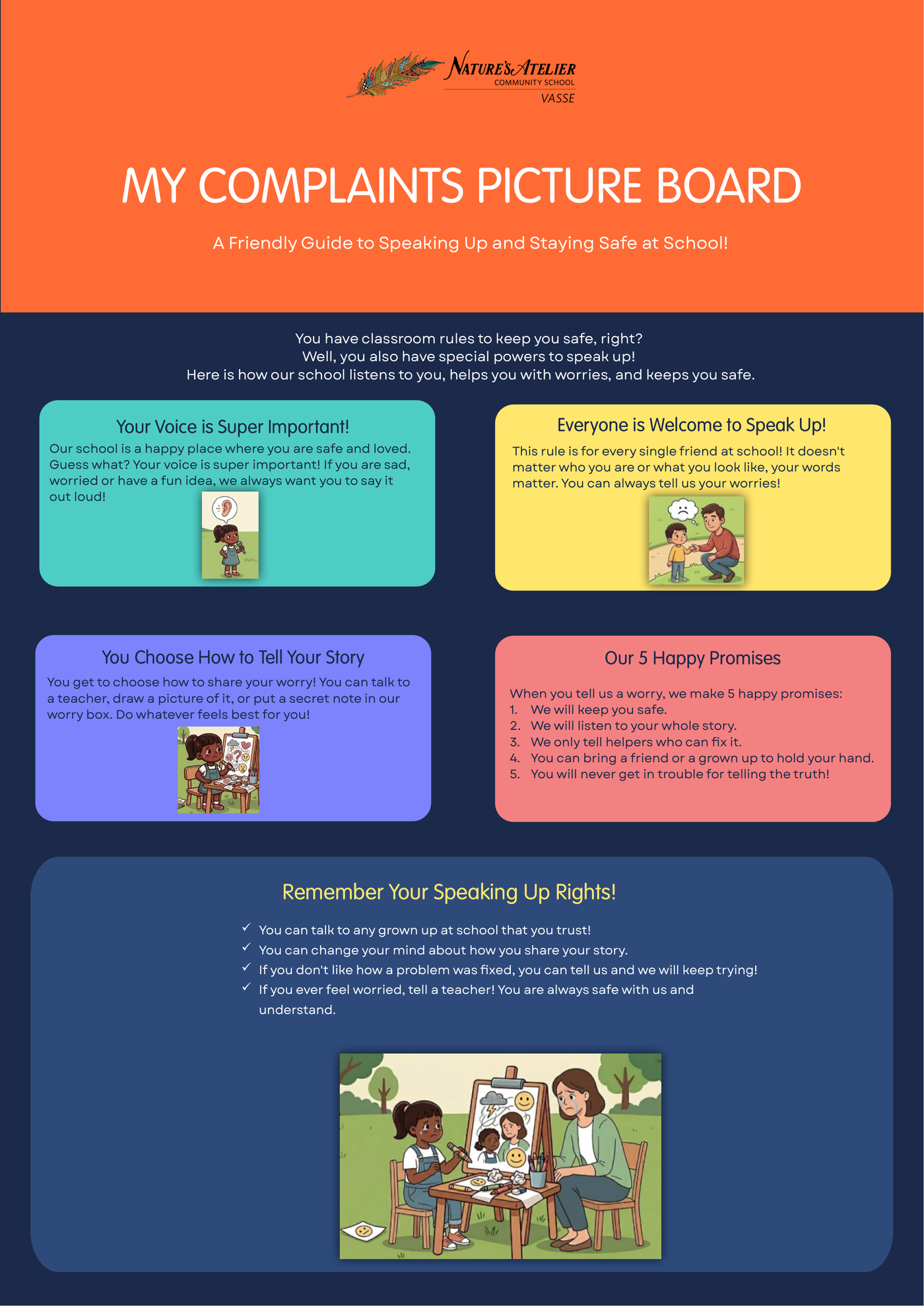
A friendly guide to speaking up and staying safe at school – written for our youngest learners.
Nature's Atelier Community School
Nature's Atelier Community School is committed to maintaining a transparent, fair, and accessible complaints management system that satisfies the expectations of the Director General of the Department of Education. We recognise that a robust grievances framework is essential for maintaining community trust and ensuring the long term wellbeing of our students and staff.
This policy ensures full compliance with Registration Standards and explicitly embeds the National Principles for Child Safe Organisations, specifically Principle 6 (Processes for complaints and grievances are child-focused) and Principle 9 (Implementation of the national child safe principles is regularly reviewed and improved). We ensure that our resolution pathways structurally prioritise student safety and well-being above institutional reputation management, and we systematically integrate complaints data into our annual risk reviews.
The purpose of this policy is to provide a structured process for resolving expressions of dissatisfaction regarding school services, conduct, or safety. By establishing these protocols, the School ensures that all complaints are handled with the necessary gravity and consistency required for a professional educational institution.
The School fulfils its statutory obligations under the School Education Act 1999 (WA) and ensures that procedural fairness is afforded to all parties involved in a dispute. By integrating these procedures into our broader governance, we ensure that every complaint is treated as an opportunity for continuous improvement and service excellence. All investigative actions are authorised under this framework to protect the integrity of the School's operations and the rights of the individuals involved.
This policy applies comprehensively to all members of the school community, including current and former students, parents, guardians, staff, volunteers, and contractors. The scope covers complaints regarding school services, specific departments, school activities, or the conduct of personnel and students. However, to ensure operational clarity and strict legal compliance, the following specific exclusions apply:
Regarding staff grievances, this policy does not apply to internal employment matters, such as payroll disputes, workplace conditions, or performance management, which are managed exclusively under separate internal Human Resources procedures. However, case managers shall not treat complaints as localized HR matters if they touch upon student safety, staff conduct toward students, or systemic operational issues. Any expression of dissatisfaction involving a child's safety or wellbeing must remain fully transparent within this compliance framework and will immediately take precedence over internal HR tracks.
In relation to child protection, the school is not authorised to independently investigate allegations of child abuse or criminal conduct; such matters must be referred directly and immediately to the Western Australian Police or the Department of Communities in accordance with state mandatory reporting obligations.
Regarding procedural support and advocacy, all complainants including students, parents, and guardians have the absolute right to be accompanied by a support person or advocate at any meeting or interview conducted during the complaints resolution process. While the support person is present to provide emotional or procedural comfort and cannot act as a legal representative, the school welcomes their involvement to ensure all parties feel safe, heard, and respected.
The school strictly adheres to the rules of procedural fairness as required under Western Australian Registration Standards. These core principles ensure that all disputes are resolved in a manner that is equitable, transparent, and legally sound.
Regarding the right to a hearing, all parties involved in a dispute have an absolute right to a proceeding that is appropriate to the circumstances of the case, which ensures that every perspective is fully considered before a formal resolution is reached.
In relation to impartial decision makers, designated personnel must act entirely without prejudice and must not have any personal or professional stake in the outcome to ensure that the wellbeing and safety of the community remain the primary focus.
Furthermore, to ensure evidence-based findings, all determinations and final resolutions must be based strictly on a logical review of the available facts and a thorough, objective inquiry into the matters in dispute.
Finally, the school provides an environment that promotes cultural safety and identity, meaning there is no challenge to a person's identity, while specifically considering and respecting the unique cultural, linguistic, and personal needs of Aboriginal and Torres Strait Islander students and families.
Complaint: An expression of dissatisfaction made to or about the school, related to its services, staff, or the complaints handling process itself, where a response or resolution is explicitly or implicitly expected.
Procedural Fairness: A process that ensures a matter is decided by an unbiased decision-maker and that those affected have an opportunity to present their case.
Child Focused: A system that is accessible to children and young people, takes their concerns seriously, and ensures their safety and wellbeing are the primary considerations.
Conflict of Interest: A situation where a decision maker's personal interests could improperly influence their professional investigation or outcome.
The School is committed to providing inclusive and accessible mechanisms for lodging complaints, ensuring that all members of the community can voice their concerns without barriers. To support this, we accept expressions of dissatisfaction in verbal, written, or anonymous forms. This multi channel approach ensures that communication preferences and individual circumstances are respected, fostering an environment of transparency and accountability.
While the School encourages complainants to identify themselves to facilitate a thorough resolution, anonymous complaints are nonetheless recorded in the formal Complaints Register. In alignment with Standard 9, the School enforces a strict triage protocol for anonymous disclosures: the potential safety risk to students or staff must be formally assessed and verified regardless of whether a name is attached to the report. The anonymity of the complainant will never be used as a justification to dismiss a child safety or systemic risk inquiry. In accordance with the Registration Standards for Western Australian non-government schools, this policy is published and maintained with high visibility on the School website to ensure the community has a clear pathway for dispute resolution.
Regarding the integrity of the grievances framework, the school is committed to investigating all genuine complaints with seriousness and respect. However, in relation to protecting the school community and staff from harassment, the school reserves the right to decline further investigation into complaints that are determined by the Principal to be vexatious, frivolous, or made in bad faith. A complaint may be classified as such if it is launched with the primary intent to cause distress, contains demonstrably false allegations, or persistently raises issues that have already been thoroughly investigated and resolved under this policy.
The School utilises a tiered approach to ensure matters are resolved at the most appropriate level:
Complainants may contact the staff member most closely connected with the issue, such as the Class Teacher, to resolve matters through respectful dialogue. The receiving staff member must immediately record any expression of dissatisfaction, regardless of whether it is framed as a minor or informal concern, into the school's central compliance system within 24 hours. The relevant staff member will acknowledge the logged concern within two working days and aim to achieve a local resolution within five working days. If unresolved after this window, or if it involves a recurring structural grievance, the compliance system will automatically triage, record, and escalate the matter to Step 2 as a formal complaint. The administrative burden of escalation does not rest on the complainant.
If the matter remains unresolved, the complainant may escalate it to a senior leader, such as a Head of Department or Deputy Principal. Senior leaders will acknowledge the escalated issue in writing within three working days and complete their review within ten working days.
Formal complaints escalated to the Principal are acknowledged in writing within five working days. The Principal will manage conflicts of interest, conduct interviews, assess student support needs, and provide a written response outlining the findings and reasons for the decision. While complex investigations may require extended timelines, the Principal will provide formal status updates every ten working days until the matter is resolved. The final written determination will explicitly outline the findings, the reasons for the decision, and the formal process for escalating the matter to the Board Chair if the complainant remains unsatisfied.
If the complainant remains aggrieved, the matter may be referred to the Chair of the Governing Body to ensure procedural fairness was maintained during the investigation.
In relation to corporate and legal accountability, a clear distinction is maintained between standard operational complaints and qualifying whistleblower disclosures. Where a complaint involves systemic wrongdoing, serious financial malpractice, or illegal conduct by the institution or its leadership, it may be escalated and managed under the school's separate Whistleblower Policy. This ensures that eligible individuals receive the specific protections, anonymity guarantees, and immunities mandated under federal legislation.
Complaints involving grooming or child abuse are strictly governed by the Child Abuse Prevention Standards and require immediate, specific action. The School prioritises the safety of children above all other operational considerations and adheres to the following mandatory protocols:
Any allegations of child abuse must be reported to the Director General of the Department of Education within 48 hours. This is a statutory requirement that ensures oversight by the regulatory body for Western Australian schools. Furthermore, matters involving sexual offences, professional misconduct of a sexual nature, or significant neglect must be reported to the Ombudsman WA under the Reportable Conduct Scheme.
The School is not authorised to investigate abuse allegations independently. Upon receiving a report, the School will immediately contact the WA Police Force or Department of Communities and must strictly follow the direction of these authorities. Internal processes are secondary to criminal and protective investigations to ensure the integrity of the evidence and the safety of the child.
The School maintains a comprehensive Complaints Register to record all formal grievances. This systematic approach ensures that the School can identify patterns, monitor response times, and provide accurate reports to the Board and regulatory bodies. To satisfy regulatory record-keeping standards, the master complaints database must permanently track five specific, uncompromised fields for every single entry:
Personal and sensitive information gathered during this process is handled with strict confidentiality in accordance with the Privacy Act 1988 (Cth). Specific retention schedules apply to meet legal and historical requirements:
In alignment with National Principle 9, the School Board regularly analyses complaints data as a standing agenda item to identify systemic trends and drive organisational improvements. Crucially, the insights and systemic trends derived from this data are formally integrated into the school's annual risk reviews to ensure active, continuous improvement of our child safe environment. This proactive review allows the Board to assess the effectiveness of current policies and implement strategic changes that enhance the School's service delivery.
Complainants are entitled to contact the Director General of the Department of Education if they are concerned with how the School has handled a complaint. The school's public complaints landing zone must clearly display the Director General's role in monitoring governance compliance, highlighting the community's absolute right to escalate unresolved registration breaches directly to the Department. While the Director General may consider whether the School has breached its registration standards, they do not have the power to override the School's final decision on a specific complaint. The School remains the final arbiter for individual grievances, provided its processes remain in alignment with the Registration Standards and Western Australian law.
Note: Printed copies of this policy/procedure are uncontrolled, and currency can only be assured at the time of printing. This policy/procedure is scheduled for review yearly from the approval date.
For Our Students
A friendly guide to speaking up and staying safe at school – written for our youngest learners.